top of page


RISING CHAIR
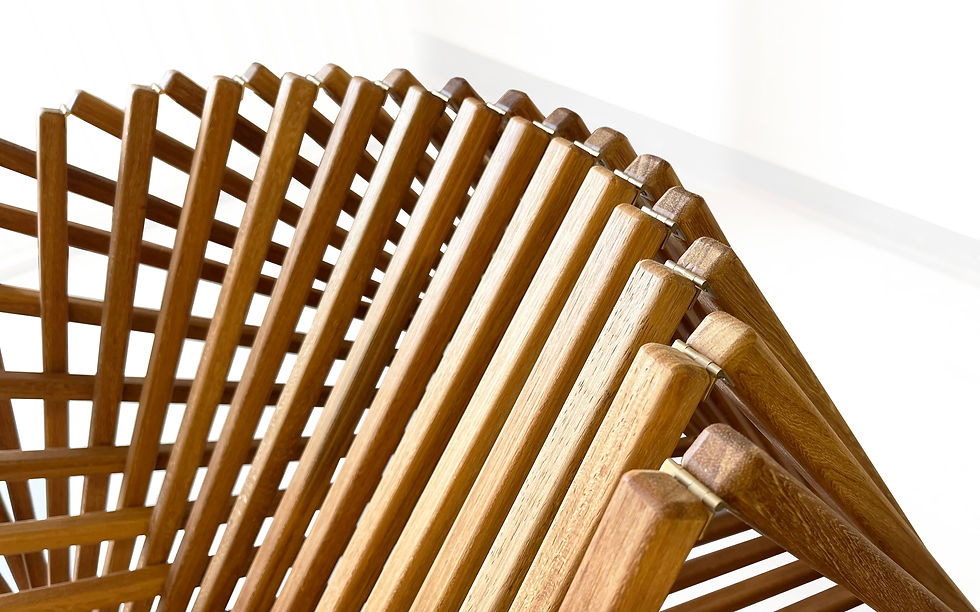
The Rising Chair explores how a minimalist flat surface can organically dictate its own three-dimensional form through transformation.
Every piece of the chair has its own task to succeed in this transformation. It’s very easy to gather a huge collection of different chairs and throughout the years there has been a staggering abundance of them, in all shapes and sizes. But what was fascinating during the research was a simple question: to what degree is the object you're creating capable of dictating its own design? Is it even possible for an object to 'tell' for which form it's best suited? And if so, what will the end result be?
The Foundation of Motion
Following this train of thought led me to discover several interesting options to create a new kind of chair. The foundation of any chair is the flat surface you'll eventually sit down on. Using this notion as a starting point, several cuts were made on the flat surface and pulled up the different beam-like strands of the cut surface. This created the preliminary but already distinct features of any chair: back, seat and legs. The rhythm of the wooden beams gives the chair an organic shape.
A Captivating Surprise
While flat, the precise incisions reveal little of the final structure, leaving the ultimate transformation as a captivating surprise. As the wooden beams arch upward, a profound connection between the material and space is born. This is determined by the various arches of the wooden beams the chair is made of.
Folding the chair into its definitive form, as a creator, a special connection to the material was born.

Transformation of the Rising Chair
1/3




EYONG

ASH

WALNUT

BLACK LIMITED EDITION


PROJECTS


bottom of page